
Land and Mortgage Register – how to verify a property’s legal status and what to watch out for?
How to verify the legal status of a property?
The Land and Mortgage Register is one of the most important sources of information about a property's legal status. It allows you to establish who owns the property, what rights are associated with it, and whether it is subject to any mortgages, easements, or other encumbrances.
Reviewing the Land and Mortgage Register is important not only when buying or selling a property, but also for property valuation, securing financing, investment planning, or resolving legal title issues. It is therefore essential to know where to find relevant information, how to interpret it, and which entries require particular attention.
Where can you access the Land and Mortgage Register?
and and Mortgage Registers are publicly accessible and can be viewed free of charge. All you need is the register number to access the official online system operated by the Polish Ministry of Justice:
Electronic Land and Mortgage Registers – ekw.ms.gov.pl
Depending on the purpose of the analysis, you can view either the current or the complete version of the Land and Mortgage Register. The latter also includes deleted entries, allowing you to trace the history of changes recorded in the register.
What information can be found in each section of the Land and Mortgage Register?
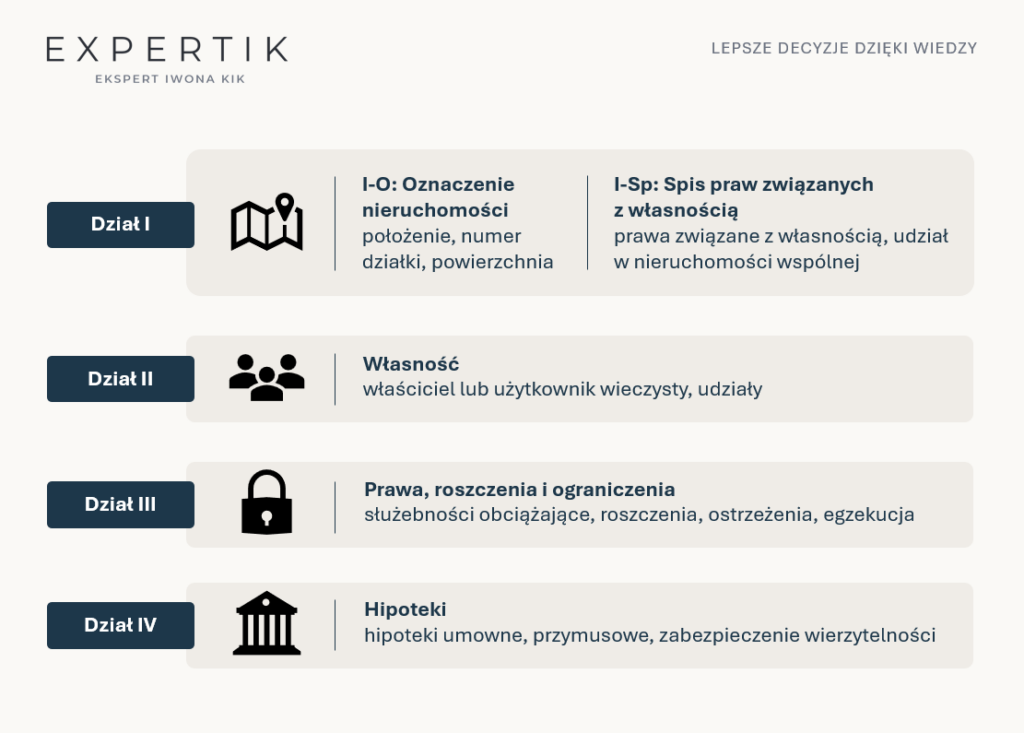
Section I-O and I-Sp – Property identification and associated rights
Section I-O (Property Identification) contains essential information identifying the property, including its location, area, cadastral parcel numbers, and, where applicable, details of the unit and its associated ancillary premises. These details should be cross-checked against the land and buildings register and other relevant documents. Any discrepancies, which may result from outdated cadastral records, should be clarified.
Section I-Sp (Register of Rights Associated with Ownership) contains rights attached to property ownership, including the ownership share in common property and easements benefiting the property, such as the right of passage on foot or by vehicle across a neighbouring plot. These rights can significantly affect how the property may be used, particularly in relation to access to a public road.
Important to note: Easements benefiting a property are recorded in Section I-Sp, whereas easements encumbering the property are generally registered in Section III.
Section II – Who owns the property?
This section contains information about the property owner or co-owners, their respective ownership shares and, where applicable, the holder of the perpetual usufruct right.
What should you look out for?
- Do the owner's details match those in the documents confirming the acquisition of the property?
- Is the property owned by a single person, or is it jointly owned by multiple parties?
- Are the ownership shares of the individual co-owners correctly specified?
Section III – Rights, claims, and restrictions
This is one of the most important sections when assessing a property's legal status. It may contain entries that significantly affect how the property can be used, its development potential, or its market value. Particular attention should be paid to:
- Easements encumbering the property – for example, the right of passage across a plot of land or the right of another person to reside in the property. Their significance depends on the type and scope of the rights established.
- Right of lifetime maintenance and residence – may involve an obligation to provide a designated person with accommodation, financial support, or care, even after the property has been sold.
- Claims and warnings – may indicate a dispute over property ownership or third-party rights.
- Entry concerning enforcement proceedings – requires a thorough examination of the property's legal and financial situation.
If any entries are unclear, it is advisable to review the underlying documents on which they are based.
Section IV – Mortgages encumbering the property
This section contains information about mortgages, which most commonly secure bank loans but may also serve as security for other claims. The mere existence of a mortgage does not mean that the property's legal status is unresolved. However, it may affect the transaction process, the ability to obtain financing, and the need to obtain additional documentation.
For example, when selling a property encumbered by a mortgage, part of the purchase price may be used to repay the seller’s outstanding loan. Once the secured debt has been fully repaid, the bank issues a document enabling the mortgage to be removed from the Land and Mortgage Register. Therefore, before completing the transaction, it is important to obtain a bank certificate confirming the outstanding loan balance and the conditions for releasing the mortgage.
It is important to remember that the mortgage amount recorded in the Land and Mortgage Register does not necessarily reflect the current outstanding debt. Particular caution is required in cases involving compulsory mortgages or where the amount of the secured debt or the conditions for removing the mortgage from the register cannot be clearly established.
Pending application notices in the Land and Mortgage Register – why are they so important?
A pending application notice indicates that a matter has been submitted to the land and mortgage register court but has not yet been resolved. It may concern, for example, a change of ownership, the registration of a mortgage, or the establishment of an easement. This means that the information currently displayed in the register may still be subject to change.
Pending application notice requires particular attention.It is essential to establish what the matter concerns and what legal consequences it may have. This is particularly important because such a notice excludes the protection afforded by the principle of public faith in the Land and Mortgage Register.
What information is not available in the Land and Mortgage Register?
The Land and Mortgage Register is a primary source of information about a property's legal status, but it does not provide a complete picture of its overall situation. It does not necessarily contain comprehensive information on outstanding payments, tenancy agreements, the technical condition of buildings, actual access to a public road, or unauthorised construction works. Certain rights, including the right of lifetime maintenance and residence, may also be legally enforceable even if they are not recorded in the register.
Therefore, examining a property's legal status should not be limited to reviewing the Land and Mortgage Register alone. Depending on the type of property and the purpose of the assessment, it may also be necessary to examine cadastral records, spatial planning documents, administrative records, and notarial deeds.
Legal basis
- Act of 6 July 1982 on land and mortgage registers and mortgages (consolidated text: Journal of Laws of 2026, item 1066) – regulates, among other matters, the establishment, maintenance and legal framework of Land and Mortgage Registers, as well as the rules governing the creation, scope and extinguishment of mortgages.
This article is for informational purposes only and does not constitute personalised legal advice.
EXPERTIK – knowledge that supports real estate decisions
The legal status of a property directly affects how it can be used, its investment attractiveness, and its market value. Simply identifying the entries in the Land and Mortgage Register is not enough. It is equally important to understand their significance and implications for the specific property.