
Property use designation – how to determine it correctly? Analysis algorithm.
How to determine the intended use of a property?
Determining the intended use of a property is a fundamental part of its analysis prior to valuation. Information on what type of development and use of the property is legally permittedis important for both market analysis and the valuation process.
In practice, the algorithm below can be used.
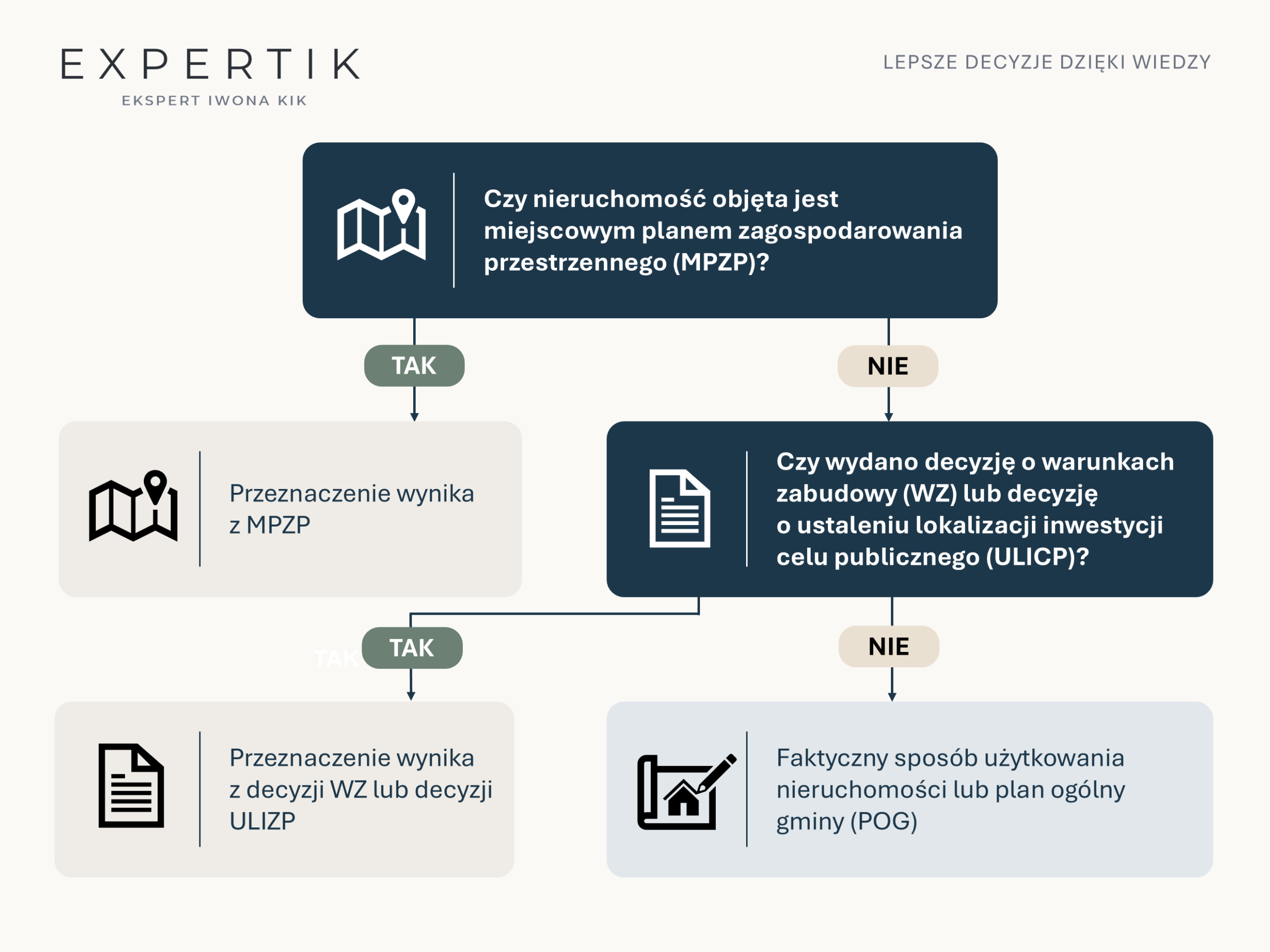
Step 1. Is the property covered by a local spatial development plan (MPZP)?
If a local spatial development plan (MPZP) is in force, its provisions constitute the primary source of information on the intended use of the land. For proper interpretation, both the textual and graphical parts of the plan should be analysed together – the designation of the land shown on the MPZP map alone is not sufficient.
Step 2. If there is no MPZP – check whether a decision on development conditions (WZ) or a decision on the location of a public-purpose investment (ULICP) has been issued.
If the property is not covered by a binding MPZP, it should be verified whether a decision has been issued for the area concerned:
- WZ decision – concerning investments other than public-purpose investments (e.g. a single-family house), or
- ULICP decision – concerning the location of a public-purpose investment (e.g. a road, school or hospital).
It is necessary to verify not only whether a decision has been issued, but also its content, scope, validity and the area to which it applies..
Step 3. No MPZP, WZ or ULICP – check the actual use of a property or the municipal master plan.
If no MPZP is in force and no relevant administrative decisions (WZ or ULICP) have been issued, the actual use of the property or the municipal master plan should be taken into account.
As of 1 September 2026, studies of conditions and directions of spatial development have ceased to have legal effect. If a municipal master planis in force in the municipality, its provisions concerning the property should be examined, in particular the planning zone and the functional profile of the zone. If neither an MPZP, a relevant administrative decision nor a municipal master plan applies to the property, the actual use of the property becomes relevant.
What is the actual use of the property?
The actual use of a property means the real and relatively permanent manner in which the property is used as of the valuation date, resulting from its actual use and function.
It should not automatically be equated with the and-use designation recorded in the Land and Property Register (EGiB), the function of a building, or the owner's declared intention. Actual use does not, in itself, determine the property's future development possibilities or its market potential.
Intended use and real estate valuation
Determining the intended use and actual use of a property is relevant, among other things, when defining the appropriate market for analysis and selecting the appropriate valuation approach, method and technique.The analysis of the property's intended use should be documented and reproducible, and the findings should be considered in the context of its condition, surroundings and the behaviour of market participants.
Legal basis
- The Act of 21 August 1997 on Real Estate Management, w szczególności:
Article 154 – concerning consideration of the intended use of the property and selection of the valuation approach, method and technique;
Article 155 – concerning data sources used in real estate valuation. - The Act of 27 March 2003 on Spatial Planning and Development – regulating, among other things, preparation of local spatial development plans and municipal master plans, as well as the issuance of WZ and ULICP decisions.
EXPERTIK – knowledge that supports real estate decisions
Proper property analysis requires not only identifying the relevant documents, but also correctly interpreting the information and assessing its significance for the specific property and market.